White Paper: Detection of Mold Allergens & Mycotoxin Genes in La Crosse, WI
This white paper describes a method to analyze common household dust for the presence of major allergen and mycotoxin producing genes.
David R Meier
1/8/20263 min read
Detection of Fungal Allergen and Toxin Associated Genetic Markers in Residential Dust
David R Meier
Abstract
Indoor environments in the La Crosse, WI region contain complex fungal communities that are incompletely characterized by traditional air sampling alone. This exploratory white paper describes the molecular detection of select fungal allergen and mycotoxin associated genetic markers in residential dust. Using quantitative PCR (qPCR), we evaluated the presence of genes associated with trichothecene biosynthesis (TRI5), aflatoxin pathway regulation (aflD, aflR), clinically relevant allergens (aspf1, Alt a 1, Pen c 13). These genes can reliably be detected in settled house dust. The presence of these genes can be associated with high-risk mold species.
Introduction
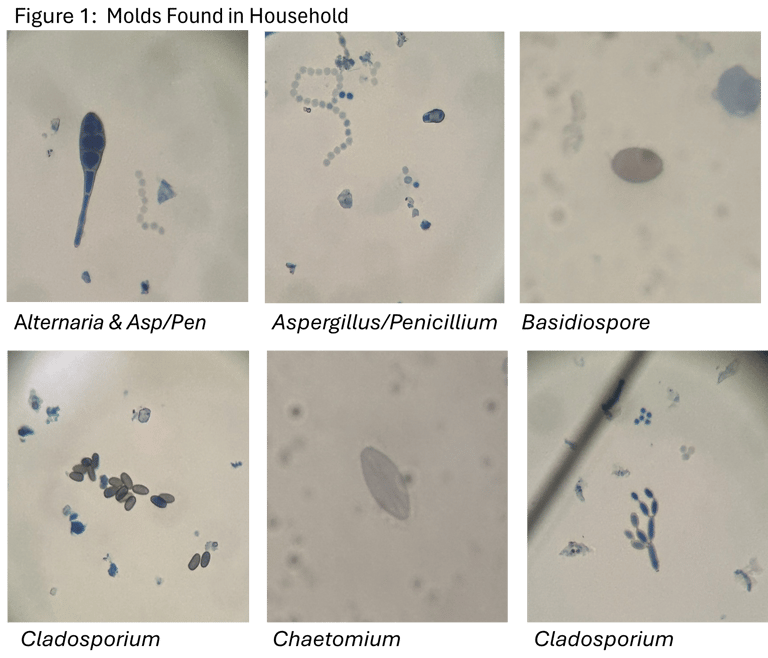
Mold testing in residential settings has historically relied on short-duration air sampling and microscopic identification of fungal spores (Figure 1). While these approaches remain useful, they are subject to temporal variability and may underrepresent chronic or intermittent fungal contributions. Dust from within a household function as passive, integrated air samplers and can accumulate particulate matter, including fungal spores and fragments over extended periods of time. Molecular techniques such as qPCR allow for sensitive detection of fungal DNA within these matrices and enable investigation of specific genetic markers associated with allergenic or toxigenic fungal taxa.
Results
Toxigenic and Allergenic Gene Detection
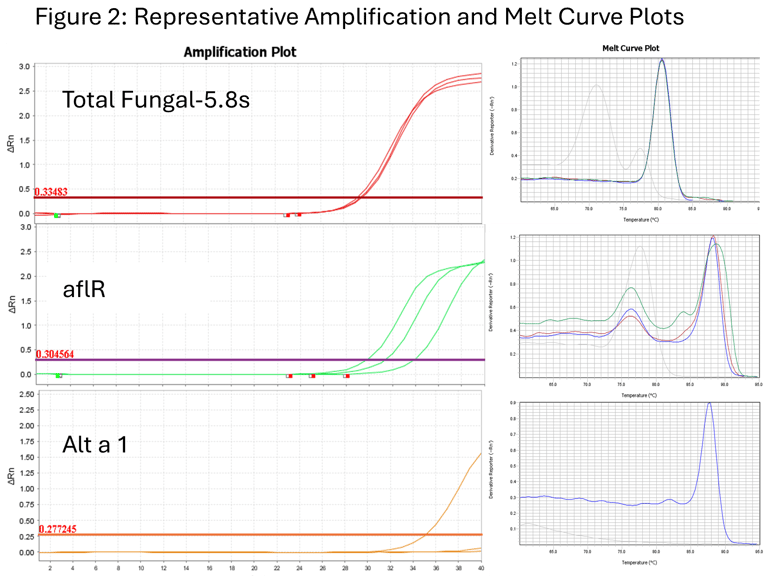
Fungal DNA was isolated using a modified CTAB extraction protocol. Isolated DNA was used in 20ul qPCR reactions using SYBR Green reporter. Total fungal load was determined using pan-fungal primers targeting the 5.8s ribosomal subunit gene. Representative amplification plots with corresponding melt curves show differing relative quantities of genes (Figure 2). Some off-target and/or primer dimer formation can be seen in some samples.
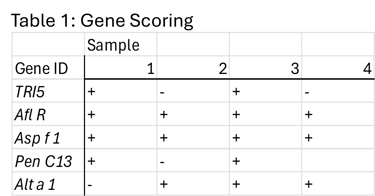
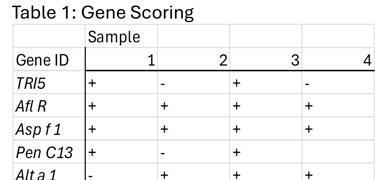
Samples were analyzed for presence vs absence of product and scored appropriately (Table 1).
Discussion & Practical Implications
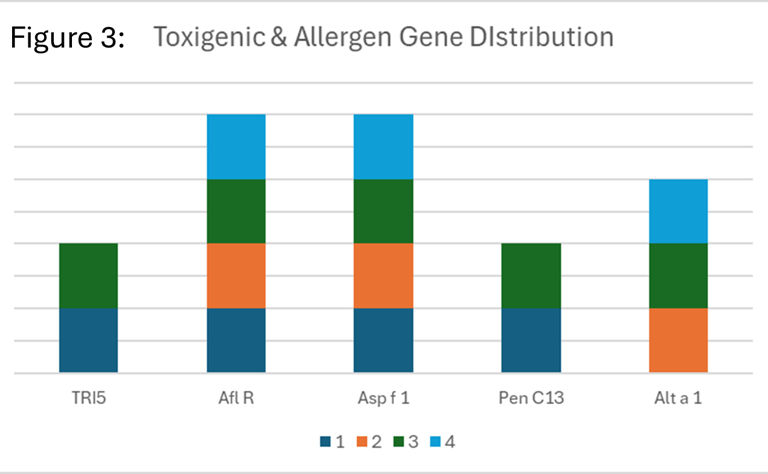
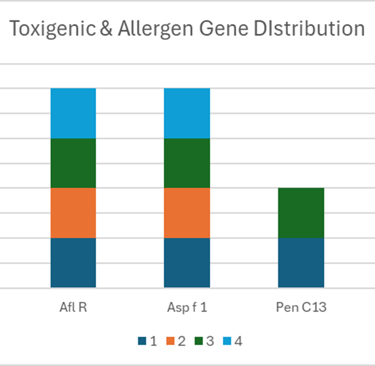
This exploratory analysis demonstrates that fungal allergens and mycotoxin associated genes can be detected in residential dust using SYBR Green qPCR. The differing fold change of these genes can also be used for determination of fungal diversity in a sample (Figure 3) The findings support the use of dust as integrative sampling matrices for molecular surveillance of indoor fungal communities. For environmental professionals, molecular analysis of dust may provide complementary information to traditional air and surface sampling by capturing longer-term fungal contributions. Relative gene signal distributions may assist in understanding the composition of indoor fungal DNA, provided results are communicated conservatively and within appropriate scientific context.
Not all molds possess the genes necessary to create mycotoxins and allergens and even within known taxa, gene presence may vary by species or strain. That’s why presence of these genes can be used as a tool to better assess the overall condition of a home. Importantly, the
presence of these genes should be interpreted strictly as evidence of genetic material from taxa known to harbor such markers, not as confirmation of toxin production, allergen expression, or health risk. Environmental conditions, substrate, and physiological state strongly influence gene regulation, and dust are expected to collect both viable and non-viable fungal material. These limitations are inherent to molecular detection methods and must be acknowledged in interpretation.
Conclusions
The detection of fungal allergen- and toxin-associated genetic markers in residential dust is technically feasible and analytically informative when framed appropriately. Used as a descriptive surveillance tool, qPCR-based analysis of dust can enhance understanding of indoor fungal complexity while avoiding unsupported claims regarding exposure or health risk. Mold inspection in La crosse, WI and want to know if your house could be containing toxic black mold?
Disclaimer: This white paper is for research and informational purposes only and does not constitute medical, toxicological, or regulatory guidance.